Screen Cornwall are always looking for ways in which we can improve our working methods so that they become greener and more sustainable.
With productions from across the UK and beyond often interested in filming in our stunning exteriors, we are conscious of the ecological impact this has on our remote and mainly rural region.
A traditional recce has an average carbon footprint of 0.14 tonnes of CO2 for a location scout to travel from London to Cornwall and back. While we have many experienced location scouts based locally who we regularly recommend, another option for locations that receive regular requests is to digitise this initial stage, at a cost of a mere 0.000006 tonnes, including the hosting and sending of the image files.
So, in the spirit of innovation, we partnered with Immersive Business at Falmouth University to trial a new way of capturing 360⁰ location photography using a stereoscopic camera. Our aim was to explore whether production companies based outside the region could work with 360⁰ images of the locations they are interested in as the first step in their process of finding the perfect spot to realise the writer/director’s vision.
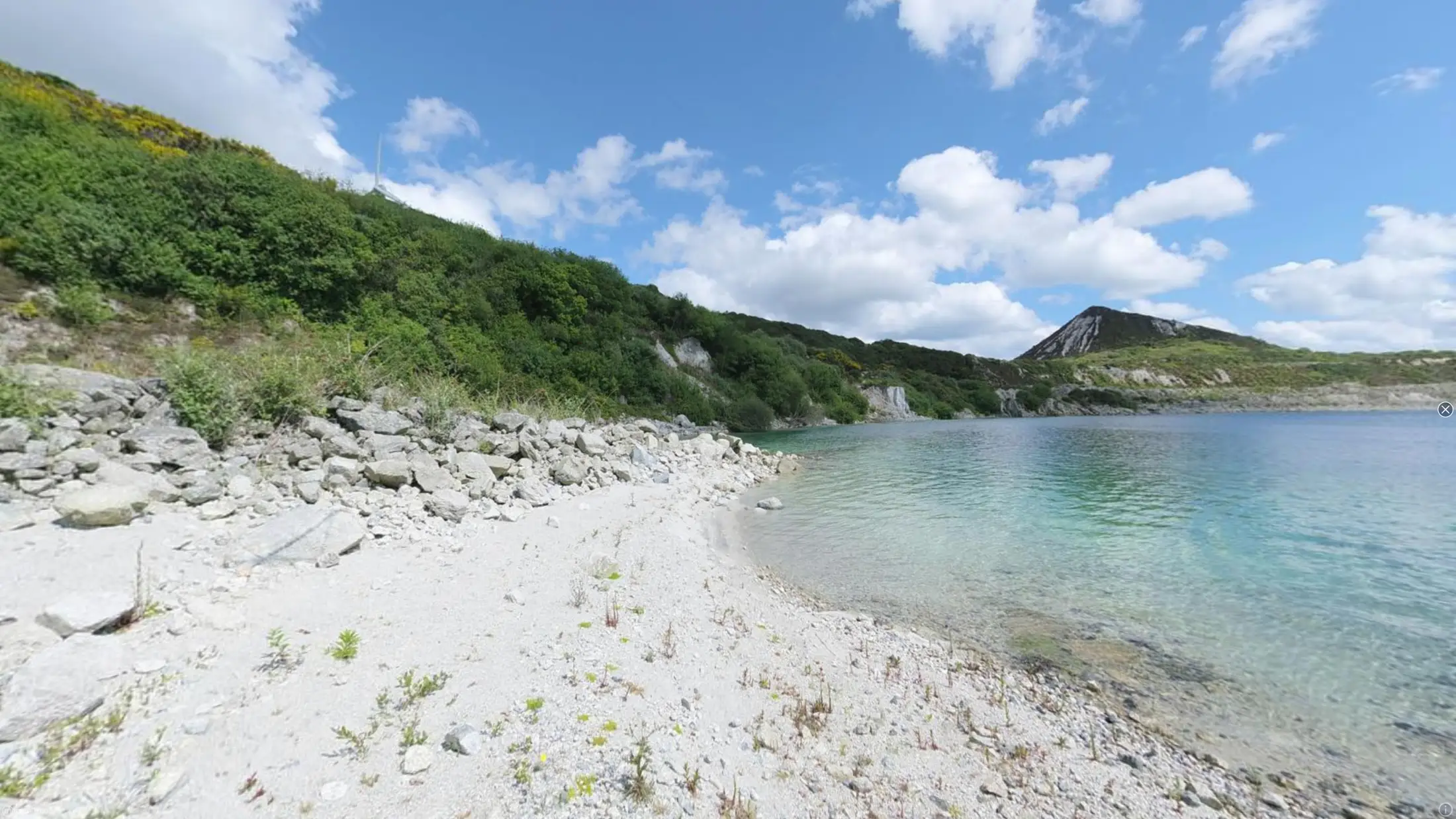
To get the ball rolling, the Screen Cornwall team ventured out with Immersive Business’ Rose Goodship and Johnny Pope to trial using the Insta360 Titan camera in a disused china clay pit filled with rainwater, now one of the largest man-made bodies of water in Europe and also one of our most unique filming locations.
The camera is controlled by a special application on a tablet. We secured the camera on a tripod and placed it on the water’s edge. Because of the 360⁰ shooting, we stepped away from the camera so as not to obscure the image and used the tablet to see what we were photographing. Using the camera in this space gave us the advantage of seeing not only the depth and breadth of the lake but also how the rock banks sloped towards the water around the edge and the scope of our access to the site itself, all within the same picture.
Once the picture was taken, the Insta360 Titan auto-stitches the media from each of its eight lenses inside the camera’s unique program, quickly and efficiently creating a 360⁰ image for production companies to view, available to send via a URL and host on a website with carbon-neutral hosting. Productions can also easily share the images, thus reducing the carbon associated with multiple uploads and downloads, as well as viewing in a VR headset, really bringing the space to life.
We’ve learned that 360⁰ footage could be a carbon efficient first stage for anyone creating a shortlist of locations to be scouted. Please do contact the team if you would like to discuss how this method could potentially work for your location or production.